
grief cartographies
(Re)mapping our grief
Tuesdays, May 12, 19, & 26
6:30 - 8:30 pm CDT // Online, via Zoom
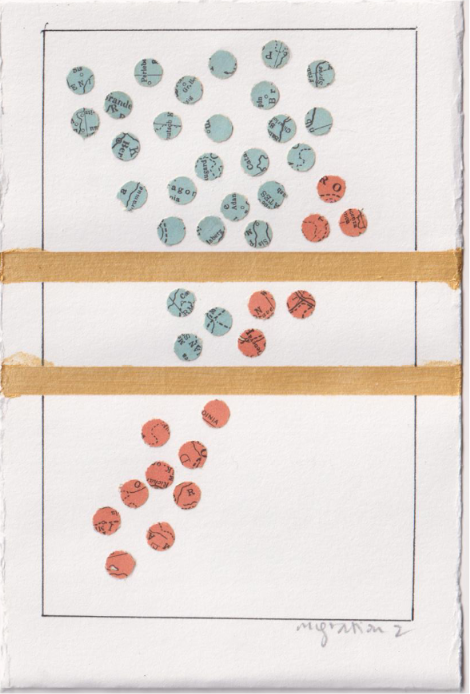
Migration 2 // Rachel Engh
Grief has a proximate nature to it–we can often recall where we were when processing our grief, where we were witness to death or significant change, and the geographic location of a life-changing event. Meanwhile, maps serve as a guide in helping us find our way, but they are also instruments informed by the bias of dominant systems and stories.
How is proximity integral to our grief work and expanding our grief awareness? How does our perception of mapping/finding our way contribute to the stories we tell ourselves about grief?
In this class, we will contemplate the relationship between grief and location, using art as a portal for mapping our grief experiences in our bodies and in place and time. We will also play with the idea of deconstruction, borders, the border (liminal) region, and borderless-ness as concepts that limit or unleash our grief experience.
This series will take place over three online sessions:
Session 1 // Tuesday, May 12
Border Regions and (Re)Imagining Borders: Deconstructing Map + Map as Guide
Session 2 // Tuesday, May 19
Proximity of Grief: Mapping Grief Locations-Individual + Collective Case Studies
Session 3 // Tuesday, May 26
Where our Grief Resides: Mapping Grief in the Body
Session 1: May 12
Border Regions & (Re) Imagining Borders: deconstructing map + Map as Guide
In Session 1, we will discuss the history of using maps as a guide to find our way. While maps become necessary when we are lost, maps implicitly outline power structures across regions via borders. We will practice holding the tension of a map’s usefulness and what their borders say about who holds power and what harm has been committed.
Together, we’ll consider the sacredness of the border region–the space on either side of an edge and how we can create practices that help us face these liminal areas with both tenderness and courage. We will play with deconstructing maps, the magic in being lost, and restructuring mapping in ways that help us imagine more porous border regions.
Finally, in thinking about our grief, we will consider how we “map” our own grief process–where we have put up borders and where our border regions exist, where we can embrace the unknown.
Session 2 : May 19
Proximity of Grief: Mapping our Grief Locations - Individual and collective case studies
The focus of Session 2 will be reflecting on our grief’s proximity and geography. Where were we in a time of grief or death and what do we remember about this place? How is/was this place comforting (or not) and what sensations does it evoke? This remembering serves to infrastructure guideposts across our grief journey–giving us important information about how we embrace grief in the future. We’ll begin to put definition around where our own rest stops, construction zones, hazards, and exits are.
We will then move into a collective case study using the example of “Metro Surge” activity in Minneapolis in late 2025 and early 2026. This will provide space to examine collective grief events, learning more about the loss and/or violence the land of a certain place was witness to and how we can more fully honor these sacred places.
We will be invited to create maps that honor/illuminate the proximity and geography of our grief experiences.
Session 3: May 26
Where our Grief Resides: Mapping Grief in the Body
Our last session will review the relationship between our physical bodies and our grief experiences. What is the map of how grief shows up in our bodies–where are our own borders and border regions? We’ll discuss research on the relationship between body/brain/spirit and how we can support our bodies as we process grief.
Knowing this information about ourselves is helpful, but the path to getting this information is often not easy. Our bodies do not reside in a society that offers supportive structures for us to seek this information and, in fact, blatantly encourage us to be disembodied. Further, the body may not always feel like a safe space, which in and of itself can be its own grief experience. We will learn ways in which we can play with the dial of inviting embodiment as we process our grief.
We will be invited to create maps that represent how and where grief shows up in our body.
what to expect
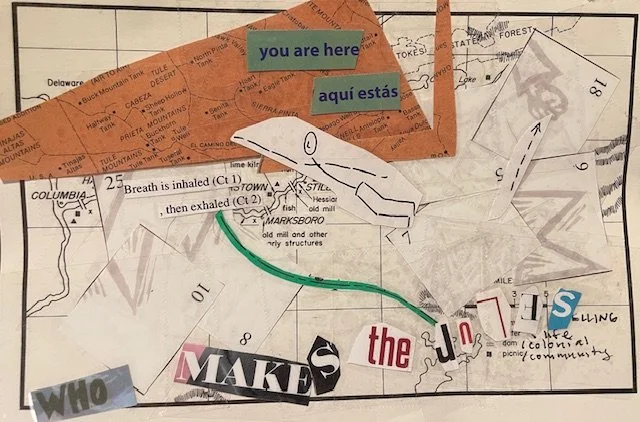
who makes the rules // sonja ausen
(Re)Mapping our Grief is a three-part series that builds upon itself over each session. Sessions will consist of:
Welcome + opening grounding
Presentation and discussion (a mix of small and large group)
Creative expression through art
Closing
Minimal supplies are needed to participate in the art portion of each session. You can find suggested supplies in the “All the Details" section found below.
Our sessions will take place virtually, via Zoom. Because this is a three-part series, session presentations will be recorded and sent out after each class if you are not able to attend any of the three live sessions.
No artist related experience needed, all are welcome!
IS GRIEF cartographies FOR ME?
This class will grow our understanding of how we find our way.
You may find this series is for you if are:
Wishing to honor the proximity and geography of your individual grief experiences or of collective grief
Seeking ways to integrate your grief through creative expression
Curious about where grief shows up in your body
Interested in learning more about liminal spaces (border regions)
Longing to connect with others who want to increase their grief resilience
Wanting to practice and alternative ways of being and doing outside of dominant systems
Engaging your imagination in how you long for the world to be
facilitators
Sonja is the founder of Wild Sea Consulting, LLC, under which she does her grief and death work. She approaches this work through a public health lens, naming our society’s grief and death illiteracy as a public health crisis. Weaving together both the soul and science of loss, Sonja focuses much of her work on the polycrisis and how both individually and collectively we can strengthen our capacity to name and integrate grief. Sonja has a Master of Public Health, Maternal and Child Health from the University of Minnesota School of Public Health and is a certified full spectrum birth doula and a trained death midwife.
Her core professional experience lies in systems creation and operations, facilitative processes, space holding, research, and grants management/ grant writing.
Finally, her work is informed by love and her own lived experience and she has been deeply influenced in both her life and training by contemplative, somatic, abolitionist, and liberationist thought and practice.You can read more about Sonja here.
sonja ausen
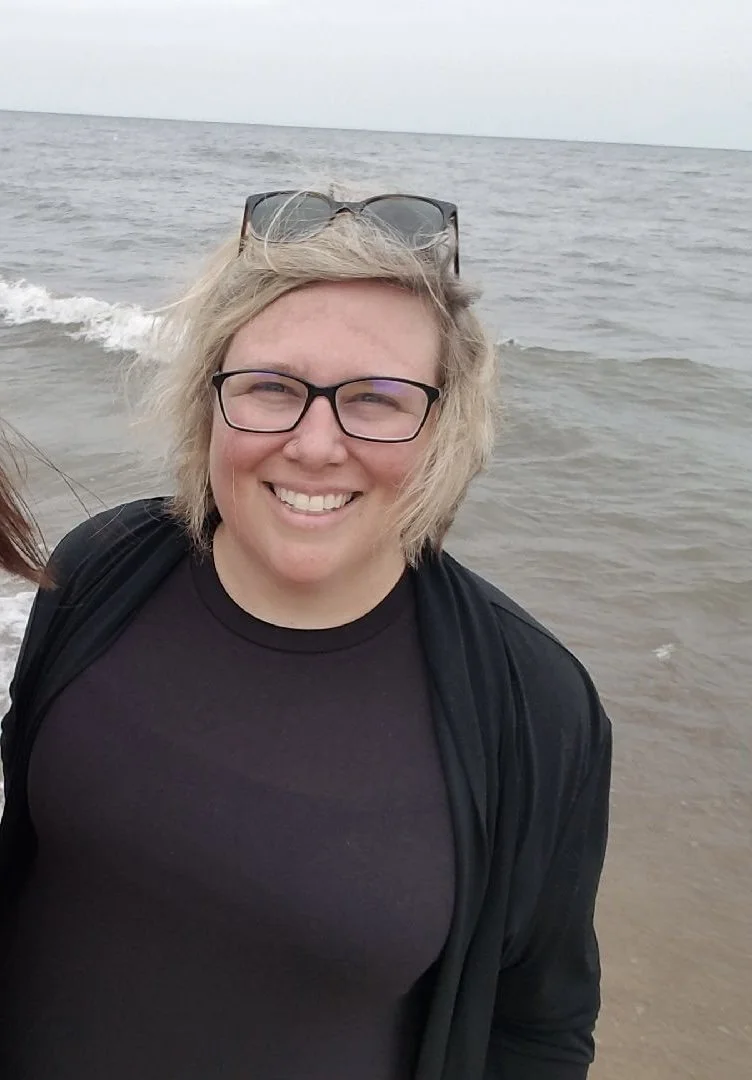
Rachel makes collages and sends snail mail to people she cares about. Through these creative practices, she explores memory, place, agency, surprise, and care. She’s inspired by artists whose projects are performed or nestled in unexpected natural and built environments. In her artwork, and in life, she is curious about different ways and reasons to ask questions & assemble and share knowledge; her first teachers in this respect are her parents–trial lawyer dad and visual artist mom–and her grandma, Dolcie, who signed letters, “stay curious.”
Rachel went to school for sociology and urban and regional planning where she learned about systems that influence peoples’ relationships with each other and with places. Today, she makes a living by supporting organizations to collect information to make program improvements and tell the stories of their efforts.
rachel engh
Date and Time: Grief Cartographies will be held over three, two-hour sessions.
Tuesday, May 12, 6:30 - 8:30 pm CDT // Border Regions and (Re)Imagining Borders: Deconstructing Map + Map as Guide
Tuesday, May 19, 6:30 - 8:30 pm CDT // Proximity of Grief: Mapping our Grief Locations-Individual + Collective Case Studies
Tuesday, May 26, 6:30 - 8:30 pm CDT // Where our Grief Resides: Mapping Grief in the Body
Price: This class is priced at two levels. Select the price point that feels most aligned with your means and financial capacity.
$375.00: This cost reflects the full cost of the offering, including time, labor, and care work. Choose this option if you have financial flexibility, stable income, or access to resources and want to help sustain this work.
$225.00: Choose this option if paying the higher rate would create strain, limit your ability to meet basic needs, or make participation feel out of reach. To pay at this tier, enter code WILDSEA at time of purchase.
Contact Sonja if a payment plan is needed or if neither pricing tier is aligned.
Supplies: Each participant will receive (via mail) a packet of supplies that they can use as part of this class and include:paper supplies such as blank white paper, a few pages of maps, translucent paper. You may also wish to have your own paper, maps, glue, tape, scissors, crayons, etc.
Location: Our sessions will take place virtually on Zoom.
We encourage live participation; however, session presentations will be recorded and sent after eacg class in the event that you are unable to attend live. Between classes, participants will be provided with prompts to support their creative practice.
Length of session: Each session is two hours, with a 5-10 minute break during the session.
Accessibility: These sessions will be held on Zoom, times listed are Central Daylight Time. Closed-captioning will be available. Each session will have one 5-10 minute break. No experience needed!